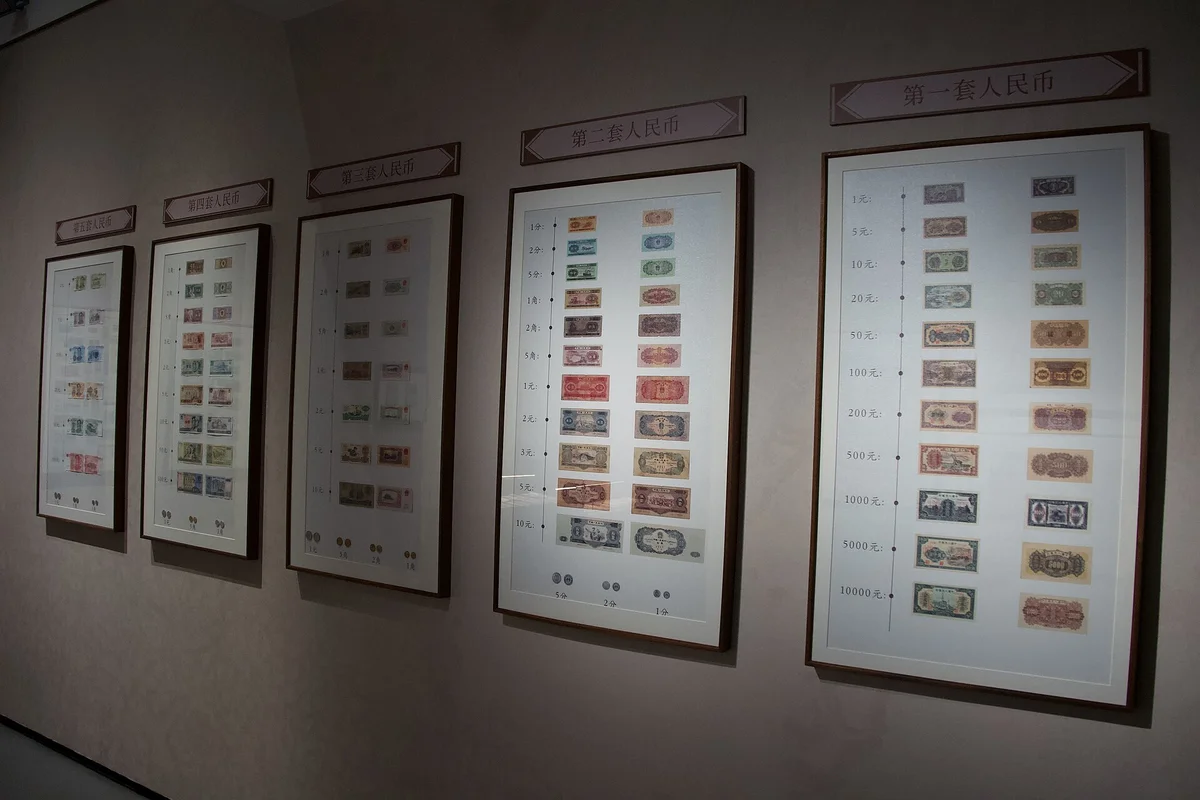
"China's cashless now, right? I don't need any money?"
This might be the question I get asked most these days 💴
It's true that China is about as cashless as it gets. I've lived in China for three years, and I've never once left home with a wallet. Just my phone. Breakfast, the metro, the supermarket — it all works.
But if you ask me "Can I go with zero cash?", the answer is no.
That's not a contradiction. Your phone covers 99% of everyday payments — but if you get stuck in the other 1%, you're really stuck. And travelers are the ones most likely to land in that 1%.
In this guide I'll cover:
- 💴 How much cash to bring
- 💱 The cheapest way to get yuan (comparing your options)
- 💳 How far a foreign credit card actually gets you
I'm 4G (Yongji), a Japanese YouTuber living in Shenzhen, and this is all based on daily life here. By the end, you'll know exactly how much to get 😊
💴 The short answer — bring "a little" cash
Here's the conclusion first:
Here's why.
| Payment method | Where it works | Role |
|---|---|---|
| 📱 Alipay / WeChat Pay | Almost everywhere | Main method — daily life runs on it |
| 💴 Cash (yuan / RMB) | Legally everywhere; in practice, it depends | Backup — carry a small amount |
| 💳 Credit card (Visa/Mastercard) directly | Only some hotels, airports, etc. | Don't count on it |
📱 Why people say you don't need cash
China's cashless culture is on a different scale from most countries.
Local diners, street stalls, the grandma selling vegetables on the sidewalk — they all have a QR code. Scan it, type the amount, done. Some shops don't even have a till 📱

It used to be that you needed a Chinese bank account to use these apps, which was a huge barrier for visitors. Now, you can link a foreign Visa or Mastercard to Alipay and pay almost exactly like a local.
That changed everything for travelers. I explain the setup step by step in How to Use Alipay in China as a Foreigner — do it before you leave home. It's the single most important part of preparing for China.
⚠️ 5 situations where you'll want cash
So why not go with zero cash? Here are the real situations where cash has saved me.
① Your phone battery dies 🔋
This is the most realistic risk.
When you travel in China, your phone does everything: maps, translation, taxis, payments. The battery drains fast. I've been down to 5% far from home more than once.
The moment your phone dies, you have no way to pay. Whether you have 200 yuan in your pocket decides how bad your day gets.
② Your payment app gets declined 📵
Payments in Alipay with a foreign card occasionally fail — your bank's fraud detection, the shop's terminal, all sorts of reasons.
In my experience it's rare, but it happens. Having your phone as your only way to pay is a bit fragile.
③ No signal 💥
QR payments need a connection. Underground passages, mountain sightseeing spots, the back of large buildings — there are places with no signal.
And remember that in China your phone may not get online in the usual way at all. I cover how to stay connected in 6 Things to Know Before Traveling to China.
④ Small family shops and rural areas 🏪
In big cities nearly every shop takes mobile payment, but in smaller towns, or at small shops run by older owners, a foreigner's app payment can cause trouble.
The staff may not be used to it, or the terminal may be old. Cash solves it on the spot.
⑤ Temples, tips and small expenses ⛩️
Some temple entry fees and donations, or pay toilets, still only take cash. Small amounts, but annoying if you can't pay.
So how much should you bring?
It depends on your trip, but here's a rough guide:
| Trip | Suggested cash |
|---|---|
| 2–3 days | 300–500 yuan |
| 4–7 days | 500–1,000 yuan |
| Mostly rural / small towns | 1,000–2,000 yuan |
Mix in small notes — 20, 10 and 5 yuan. Hand over a 100-yuan note at a street stall and you may hear "no change" 💴
💱 Where to get yuan — comparing your options
Now the main question: where do you get your yuan?
| Method | Rate | Convenience | Recommendation |
|---|---|---|---|
| 🏠 Exchange at home (bank / exchange office) | △ | ○ | ★★★☆☆ |
| ✈️ Exchange desk at a Chinese airport | ✕ | ◎ | ★☆☆☆☆ |
| 🏦 Chinese bank counter | ◎ | ✕ | ★★☆☆☆ |
| 🏧 Withdraw from an ATM in China (debit card) | ○ | ○ | ★★★★★ |
① Exchange at home 🏠
Pros: You land with cash in your pocket.
Cons: The rate is usually poor — a margin is built into the exchange rate, so you'll typically lose a few percent. And yuan isn't always easy to get: in many countries banks need to order it in advance, and in some (including much of Latin America) it's hard to find at all.
My take: Fine for a small amount if it's easy where you live. "Having cash the moment you land" is worth a few percent on 300–500 yuan.
② Exchange desk at a Chinese airport ✈️
Pros: You can do it after you arrive.
Cons: Poor rates. Airport exchange desks usually have high margins and sometimes a per-transaction fee.
My take: Avoid it unless it's an emergency. If there's an ATM in the same terminal, it's almost always the better deal.
③ Exchange at a Chinese bank counter 🏦
Pros: The best rate — close to the official rate.
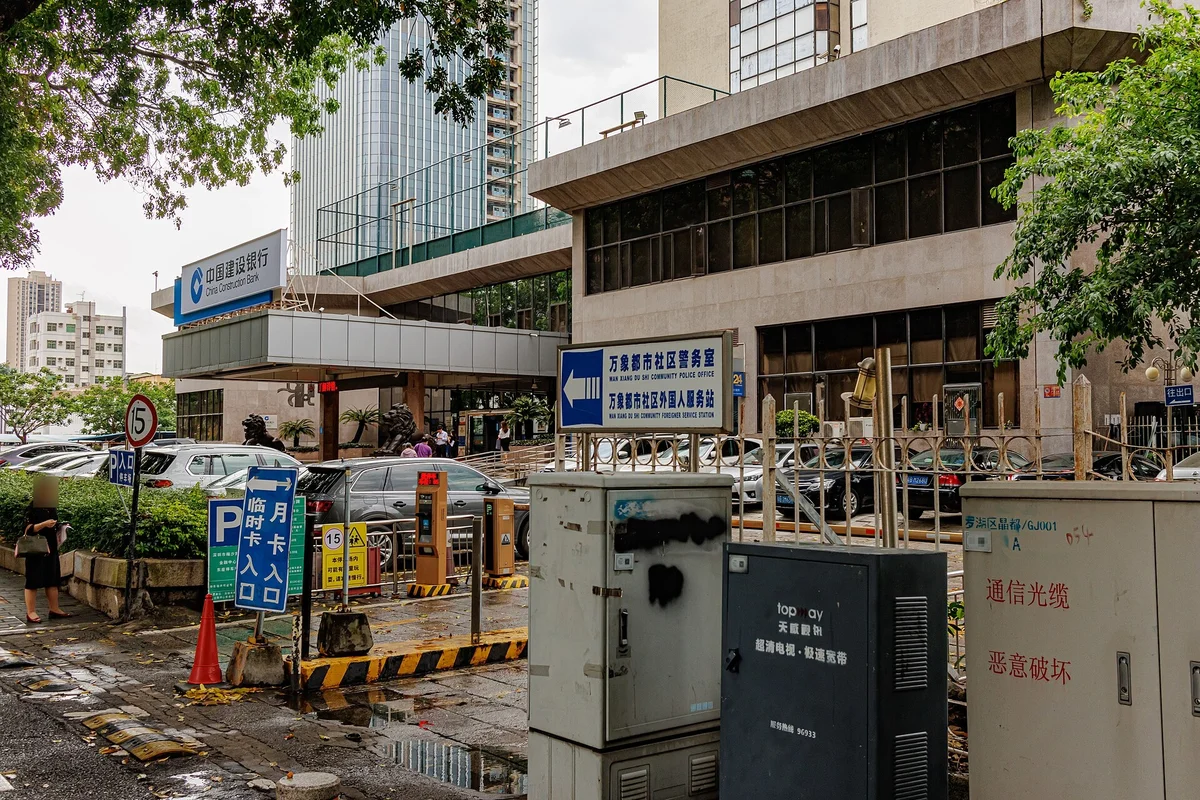
Cons: It's a hassle.
- 🛂 Passport required
- 📝 A form to fill in (Chinese or English)
- 🕒 Weekday opening hours only (many counters are closed at weekends)
- ⏳ 30 minutes to an hour is not unusual
- 🏦 Some branches don't handle foreign currency at all
My take: Not worth it for most travelers — you'll lose precious sightseeing time. It makes sense for long stays and large amounts.
④ Withdraw from an ATM in China 🏧 ← my top pick
Use the card from your home bank to withdraw yuan directly from a Chinese ATM.
This is what I recommend most.
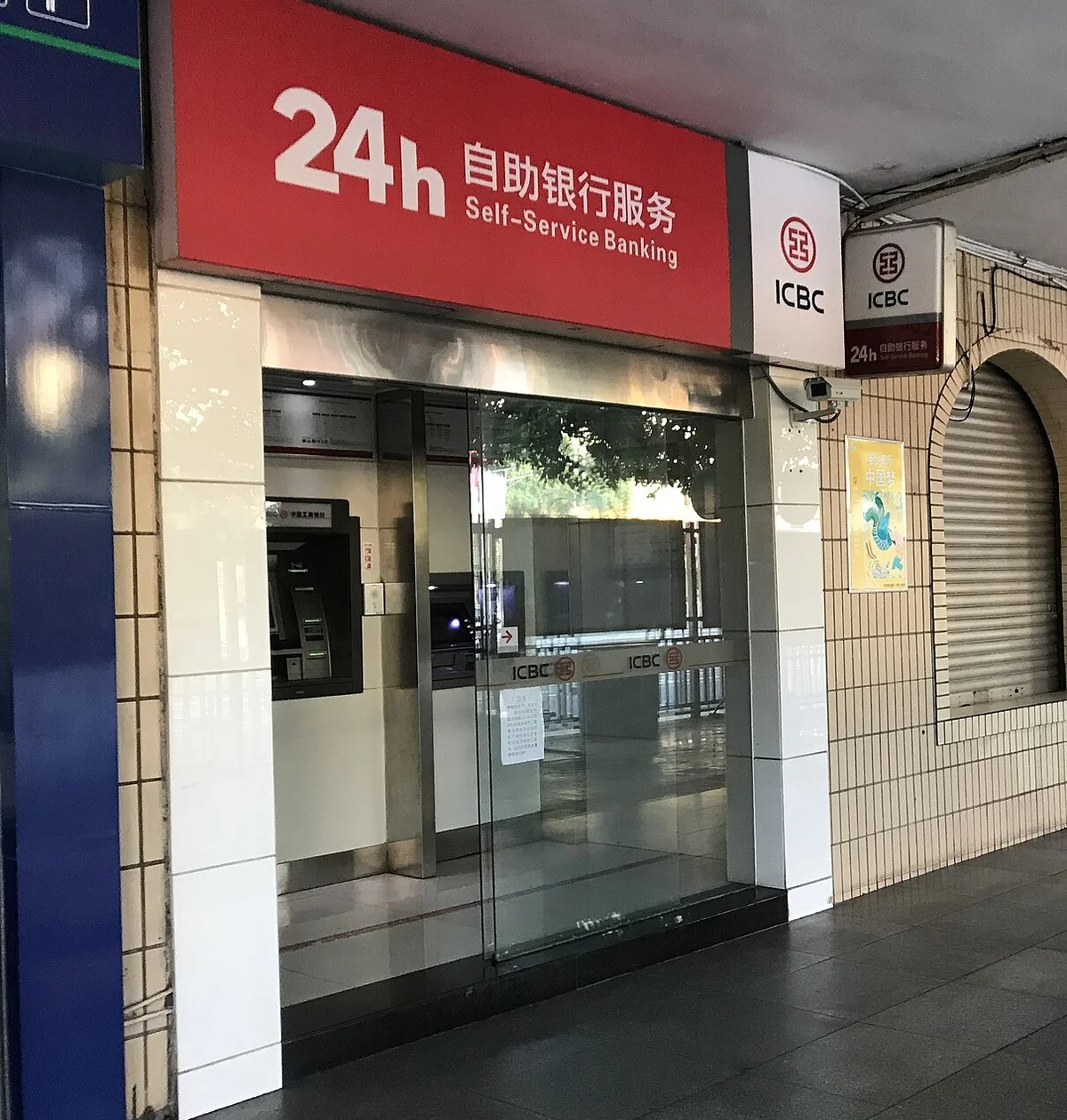
Pros:
- 🕛 Available 24/7 (look for "24h 自助银行服务" — 24-hour self-service banking)
- 💹 A good rate (your card network's rate)
- 🗺️ ATMs are everywhere — bank branches, stations, airports, next to convenience stores
- 🌐 You can switch the screen to English
The key question is which card you use. Same ATM, very different costs depending on the card.
💡 Best option: a debit card
A debit card takes money straight from your own account. You're not borrowing anything.
- ✅ No interest (it's not a loan)
- ✅ Nothing to repay when you get home
- ✅ Your costs are basically your bank's foreign transaction fee (if any) plus the local ATM fee
- ✅ You can't withdraw more than you have, so no risk of overspending
If you don't have one, many banks and digital banks offer debit cards designed for travel with low or no foreign fees. Getting one before you go removes almost all your exchange worries 💳
Only have a credit card? That's a cash advance
Without a debit card, you'd use your credit card for a cash advance.
It works, but there's a big difference:
| Debit card | Credit card (cash advance) | |
|---|---|---|
| What it is | Your own money, taken immediately | A loan |
| Interest | None | Charged from day one (usually) |
| Extra fees | Foreign/ATM fees | Often a cash advance fee too |
| Before you go | Nothing special | Make sure cash advances are enabled and you know your PIN |
With a cash advance, interest usually starts on the day you withdraw. Pay it off as soon as you can 📅
Using the ATM isn't hard
Chinese ATMs look intimidating, but almost all of them have a language option, and English is enough to get through. The words you'll see are things like "Withdrawal" and "Balance".
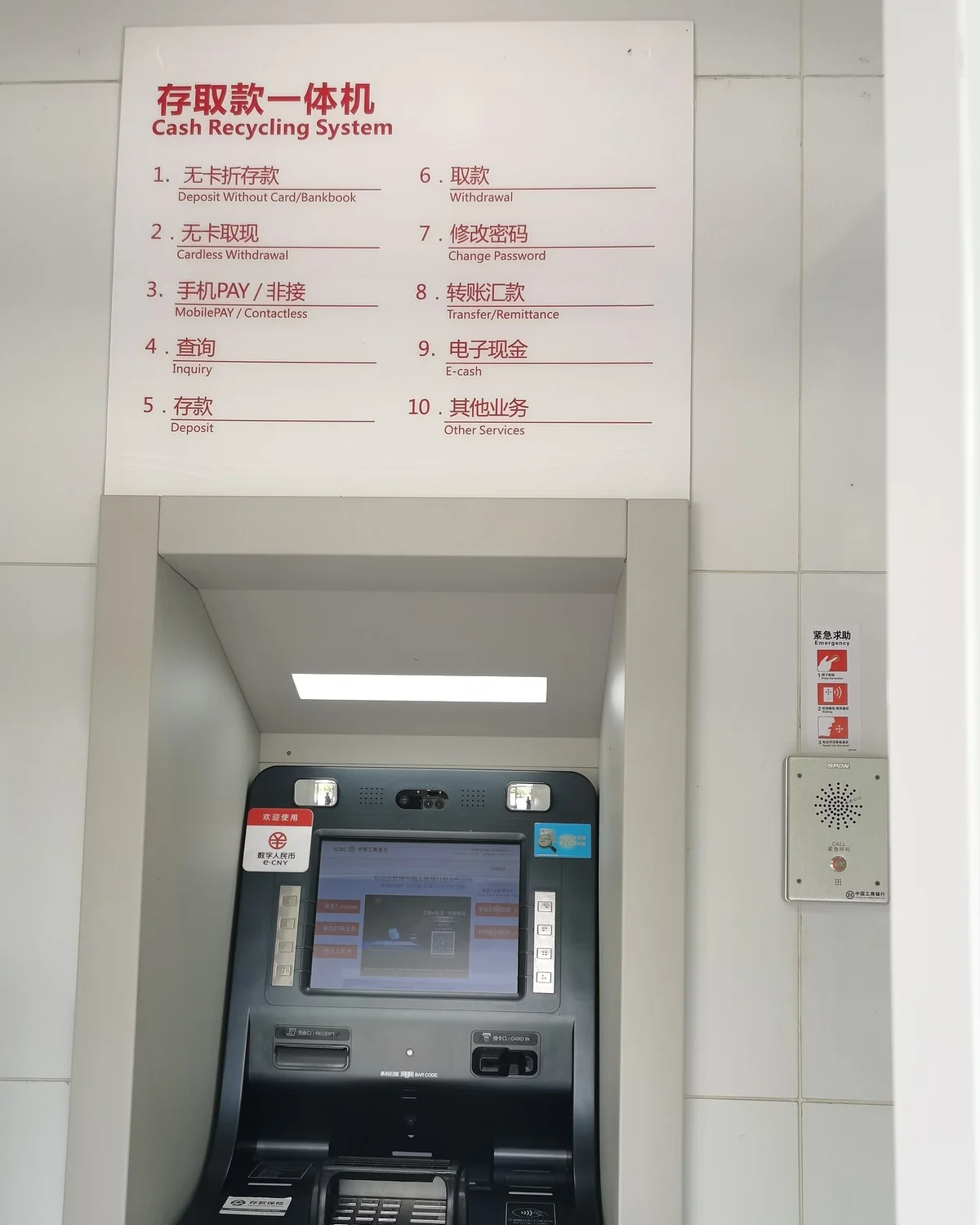
A few Chinese words that help:
| Chinese | Pinyin | Meaning |
|---|---|---|
| 取款 | qǔkuǎn | Withdrawal (press this) |
| 存款 | cúnkuǎn | Deposit |
| 查询 | cháxún | Balance inquiry |
| 转账汇款 | zhuǎnzhàng huìkuǎn | Transfer |
| 修改密码 | xiūgǎi mìmǎ | Change PIN |
| 语言 / Language | — | Switch language |
💡 Per-withdrawal limit: Bank of China states that ATM withdrawals with foreign cards in China are limited to 3,000 yuan per transaction, and other machines are often similar or lower. Daily limits depend on your own bank. Local ATM fees are often around 15–30 yuan per withdrawal, so one larger withdrawal is usually cheaper than several small ones.
My recommended combo
💳 How far does a foreign credit card get you?
People often get this wrong, so I'll be clear:
In China, you can rarely tap or swipe a foreign credit card directly in shops.
If you think "I've got Visa, I'll be fine anywhere", you'll get stuck. The places that take it directly are far fewer than visitors expect.
Why? Fees.
It comes down to merchant fees.
Merchant fees for Alipay and WeChat Pay are much lower than for international card networks like Visa and Mastercard.
And in China, nearly everyone uses Alipay or WeChat Pay.
Put yourself in a shop owner's shoes:
- 🇨🇳 Almost every customer pays by QR code
- 💰 QR payments cost much less than international cards
- 🧾 Accepting international cards means buying a terminal and paying higher fees
There's simply no reason to bother. It's not a technical problem and not about keeping foreigners out — it's just economics 💡
Where cards do work: places with lots of foreigners
It's not that cards never work. Where there are many foreign customers, it's worth accepting them.
- 🏨 Hotels popular with foreigners
- 🍽️ Upscale restaurants that foreigners visit
- ✈️ Airports and duty-free shops
Elsewhere, don't count on it.
| Place | Visa / Mastercard directly |
|---|---|
| 🏨 Hotels with many foreign guests | ✅ Usually |
| ✈️ Airports / duty-free | ✅ Yes |
| 🍽️ Upscale restaurants popular with foreigners | ⭕ Often |
| 🏬 Big department stores / international chains | ⭕ Sometimes |
| 🍜 Local diners and restaurants | ❌ Rarely |
| 🏪 Convenience stores / small supermarkets | ❌ Rarely |
| 🚕 Taxis | ❌ No |
| 🚇 Metro ticket machines | ❌ No |
| 🍢 Street stalls | ❌ No |
So think of your credit card as "for paying the hotel" and "emergency backup". Don't plan to use it directly while you're out and about.
The answer: link your card to Alipay
Does that make your credit card useless? Quite the opposite.
Link your card to Alipay, and you can use it all over China — at street stalls, in taxis, on the metro.
That's the best setup in 2026. Instead of using your card at a terminal, you run it through Alipay and onto China's QR payment network 💡
Watch out for the fee on larger payments
When you pay through Alipay with a foreign card, payments of 200 yuan or less are free, and larger payments carry a 3% service fee on the full amount (there are also per-transaction and annual limits).
These rules can change, so check what the Alipay app shows when you pay. It's not a lot of money, but it's nicer to know in advance.
💵 Other things worth knowing about cash
Counterfeit notes are rarer — but not gone
Thanks to the cashless shift, the chance of getting a fake note in China has dropped a lot — there's just much less cash around.
But it's not zero, especially with 100-yuan notes. Only exchange money at banks, official exchange desks or ATMs, and never follow a "money changer" who approaches you on the street 🚫
What to do with leftover yuan
- 💴 Keep it for next time — easiest if you'll be back
- 🏠 Exchange it back at home — expect a poor rate (and it may not be possible everywhere)
- 🛍️ Spend it at the airport — duty-free or snacks
Also, if you want to change yuan back into foreign currency inside China, you may be asked for your original exchange receipt. Keep bank receipts until your trip is over 🧾
Coins vs. mobile payment
Chinese coins (1 yuan, 5 jiao, 1 jiao) are hardly used anymore, and change in coins is hard to spend.
For small purchases, mobile payment is more reliable — carrying notes only is fine.
❓ FAQ
Q. Is it risky to bring no cash at all? A. I wouldn't do it ⚠️ Your phone covers daily payments, but a dead battery, an app problem or no signal leaves you stuck. Even 500 yuan as a backup is enough.
Q. Can I pay with US dollars or euros in China? A. No. Only yuan is accepted for everyday payments. Exchange or withdraw yuan.
Q. Is it cheaper to exchange at home or in China? A. On rate alone, a Chinese bank is best — but it's slow. For convenience plus a good rate, an ATM in China with a debit card is the best balance.
Q. Should I use a debit card or a credit card at the ATM? A. A debit card 💳 A credit card withdrawal is a cash advance — a loan — so interest and extra fees usually apply. With a debit card, you mostly pay foreign transaction and ATM fees.
Q. The ATM says my card can't be used. What now? A. First try another bank's ATM. Bank of China (BOC), ICBC and China Construction Bank (CCB) generally handle foreign cards well. If it still fails, check your balance and that overseas use is enabled (debit) or that cash advances are enabled (credit), and call your bank.
Q. A shop said "no cash". Isn't that illegal? A. Legally, refusing yuan cash is prohibited. But arguing on the spot usually wastes time — switching to mobile payment or going to another shop is faster 😅
Q. Can I tap my credit card on the metro? A. More and more cities accept contactless cards at metro gates (Beijing, Shanghai, Guangzhou, Shenzhen, Chengdu and others). Shops generally don't. Details in How to Ride the Metro in China.
Q. Should I get a UnionPay card before I go? A. Not necessary. A UnionPay card issued outside mainland China doesn't always work the same way inside China. I tried one issued in Japan, and despite the "UnionPay" logo it failed more often than not 😅 Alipay and WeChat Pay are all you need.
📌 Summary
- 💴 Bring 500–1,000 yuan in cash. Zero is risky; a lot is unnecessary
- 📱 Pay mainly with Alipay, with your foreign card linked before you leave home
- 🔋 You'll want cash for a dead battery, app problems, no signal, small rural shops and temples
- 💱 A little yuan from home (if it's easy) + top up at a Chinese ATM is the best balance
- 🏧 At the ATM, use a debit card — no interest, minimal fees. Always choose to be charged in yuan
- 🏦 Chinese bank counters have the best rate but are weekdays only and slow — not for most travelers
- 💳 Visa/Mastercard work directly only at hotels, upscale restaurants and airports — elsewhere, run them through Alipay
- 🧾 Keep your exchange receipts until the end of your trip
China's cashless system is wonderfully convenient — if you've prepared. Show up unprepared and it can feel less convenient than home.
You only need to do two things: set up Alipay before you go, and put a little cash in your pocket. Do that, and paying in China won't be a problem 😊
📚 Read next
- 💳 How to Use Alipay in China as a Foreigner — the "most important preparation" above, step by step with screenshots
- 💚 How to Set Up WeChat Pay as a Foreigner — the other big payment app. With both, you'll rarely need cash
- 🎒 6 Things to Know Before Traveling to China — internet, toilets, plugs and more
- 🚇 How to Ride the Metro in China — where contactless cards and cash work on the metro
- 🍜 How to Order with a QR Code in Chinese Restaurants — order and pay at restaurants without cash
- 🛂 China Arrival Guide: Immigration, Fingerprints and Customs — the cash amounts you must declare at customs
Information current as of October 2026. Fees, limits and rules change — please check with your bank and in the Alipay app before you travel.
Image credits: Wikimedia Commons — historic RMB notes on display (Hangzhou): User:CatOnMars (CC BY 4.0) / ICBC 24-hour self-service bank: MNXANL (CC BY-SA 4.0) / ATM menu: Shwangtianyuan (CC BY-SA 4.0) / China Construction Bank, Luohu, Shenzhen: Dinkun Chen (CC BY-SA 4.0) / Shenzhen supermarket: TIADMEAEYPM (CC0)