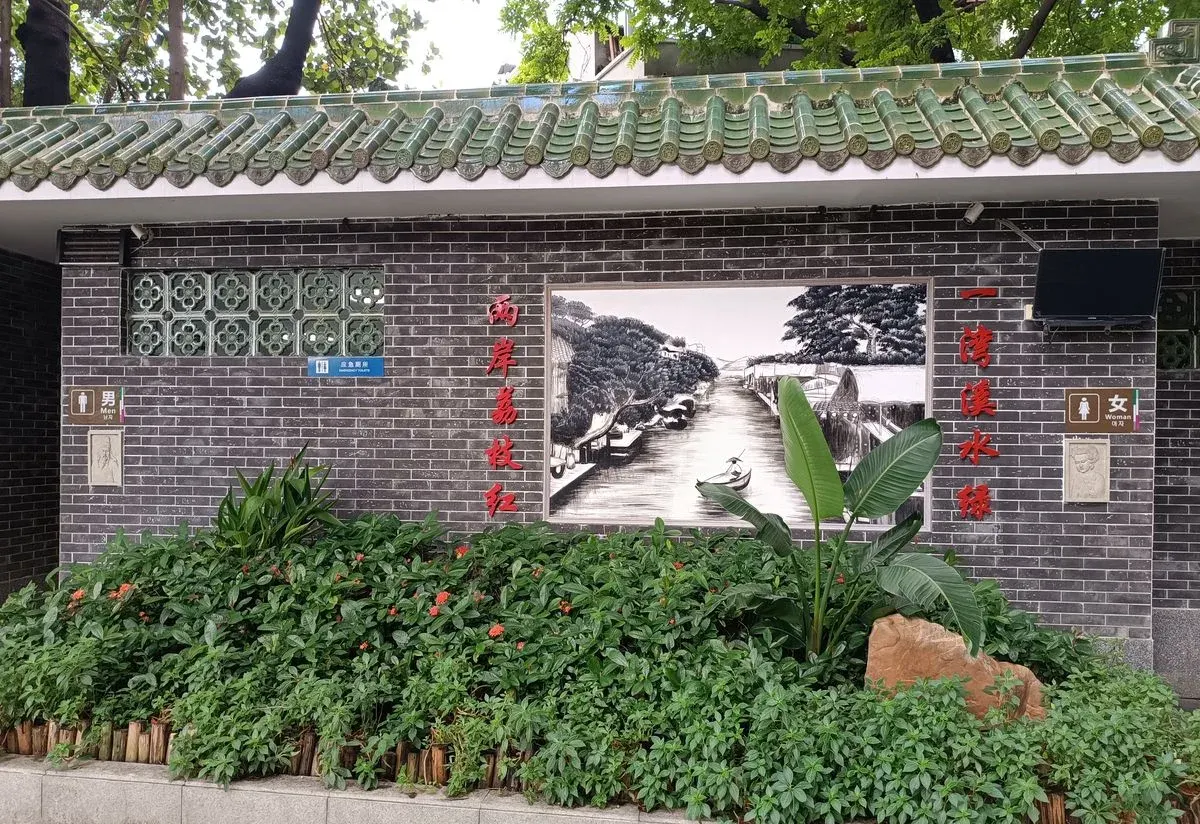
When you prepare for a trip to China, you read a lot about entry rules, Alipay and the internet restrictions. But the first "nobody told me!" moment on the ground is usually the toilet 🚻
I'm 4G (Yongji), a Japanese YouTuber who has lived in China for more than three years — I'm based in Shenzhen now. When friends visit from abroad, almost all of them get caught out at the same moment: they walk into a stall, close the door, and realize —
there's no paper.
In this guide I'll go through what actually trips up visitors in Chinese toilets, based on how things are in 2026. A lot of what you'll find online is more than ten years old ("Chinese toilets have no doors!"), and cities have changed a lot since then. There's no need to be scared. But there are three things that will definitely catch you out if you don't know them, and one habit that may surprise you.
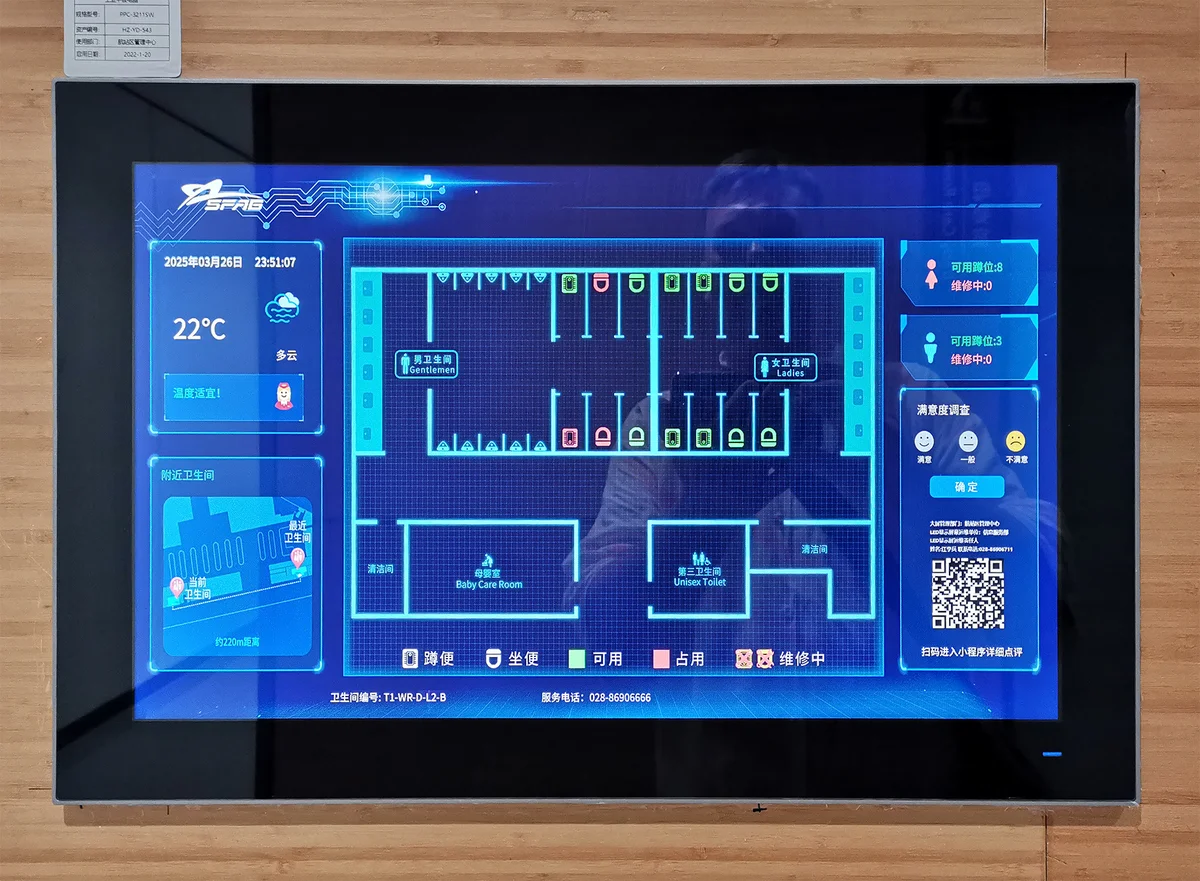
The photo above is the display at the entrance to a restroom at Chengdu Tianfu International Airport. Before you even walk in, it shows which stalls are free and whether each is a squat toilet (蹲便) or a sit-down toilet (坐便). If you arrive expecting "Chinese toilets = dirty", moments like this come as a pleasant shock.
🚻 The short answer — what really matters
Here's the summary first. Details below.
| # | What to watch out for | What to do | Importance |
|---|---|---|---|
| 1 | Some places have no toilet paper | Always carry pocket tissues | ⭐⭐⭐ |
| 2 | Some places say don't flush the paper | Put it in the bin next to the toilet. Look for the sign | ⭐⭐⭐ |
| 3 | Lots of squat toilets | Check the sign outside the stall to find a sit-down one | ⭐⭐ |
| 4 | People smoking inside the restroom | Nothing you can do. Try upper floors of malls | ⭐⭐ |
| 5 | Small local places and rural areas can be dirty | Head for malls and metro stations | ⭐ |
| 6 | Stall locks are sometimes broken | Push the door to check before going in | ⭐ |
🧻 Watch out #1: there may be no toilet paper
This is the biggest trap.
In many countries you assume there will be paper, so you don't check before you go into the stall. In China, you need to check every time.
Why isn't there any?
Simple: people take it home. Rolls in each stall disappear so fast that it isn't worth the cost, so for a long time the norm in China has been "bring your own paper".
It surprises visitors, but almost everyone in China carries pocket tissues. It's so normal to locals that nobody thinks to tell you.
In 2026: it depends on where you are
That said, things have changed a lot in recent years. In cities, more and more restrooms do have paper.
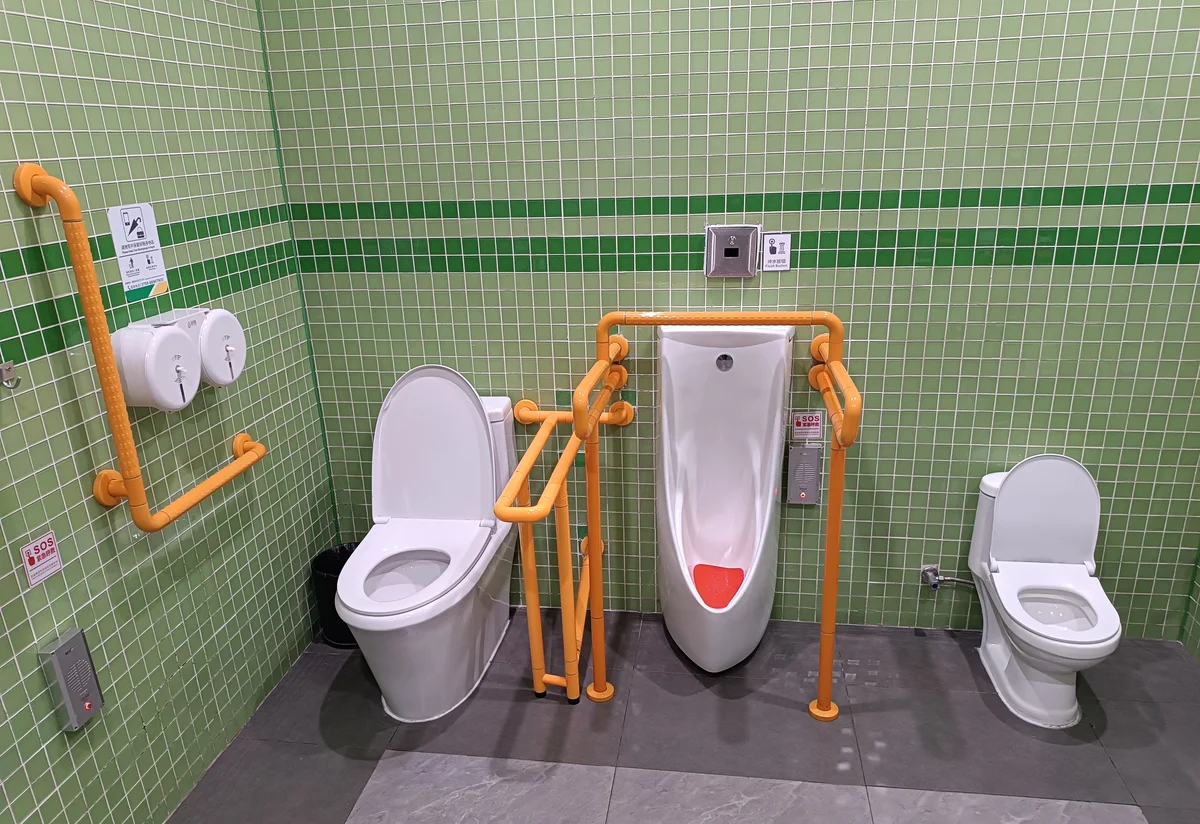
This is a restroom in a Shenzhen metro station — there are two big roll dispensers on the left wall. Newer stations and shopping malls increasingly have shared paper at the entrance or by the sinks.
Here's the key point:
Some tourist sites even have face-recognition toilet paper dispensers (人脸识别厕纸机). One installed at the Temple of Heaven in Beijing made headlines: you scan your face and it gives you a fixed amount of paper, to stop people taking whole rolls. A very Chinese solution — but not something to rely on.
What to bring and where to buy it
- Bring plenty of pocket tissues from home (they take up no space — around ten packs is a good amount)
- In China you can buy them at any convenience store (便利店), supermarket or pharmacy for a few yuan
- Pocket tissues are 纸巾 (zhǐjīn) in Chinese
- Wet wipes (湿巾 / shījīn) are handy too, for wiping your hands
🗑️ Watch out #2: some places say don't flush the paper
Another easy mistake.
In some Chinese toilets, you put used paper in the bin next to the toilet instead of flushing it, because the pipes are narrow and clog easily.
How to tell: look for a sign
You may see a sign like these on the stall wall:
| Chinese | Meaning |
|---|---|
| 请将纸巾丢入纸篓 | Please put paper in the bin |
| 纸巾请勿丢入便池 | Do not throw paper into the toilet |
| 手纸入篓 | Paper in the basket |
纸篓 (zhǐlǒu) means wastebasket. If you see those two characters, don't flush — use the basket.
In 2026
Honestly, in newer city buildings you can usually flush paper normally. In Shenzhen's malls and newer metro stations, it's rarely been an issue for me.
The ones to watch are older buildings, smaller towns, local eateries and public toilets at tourist sites.
🚾 Watch out #3: lots of squat toilets
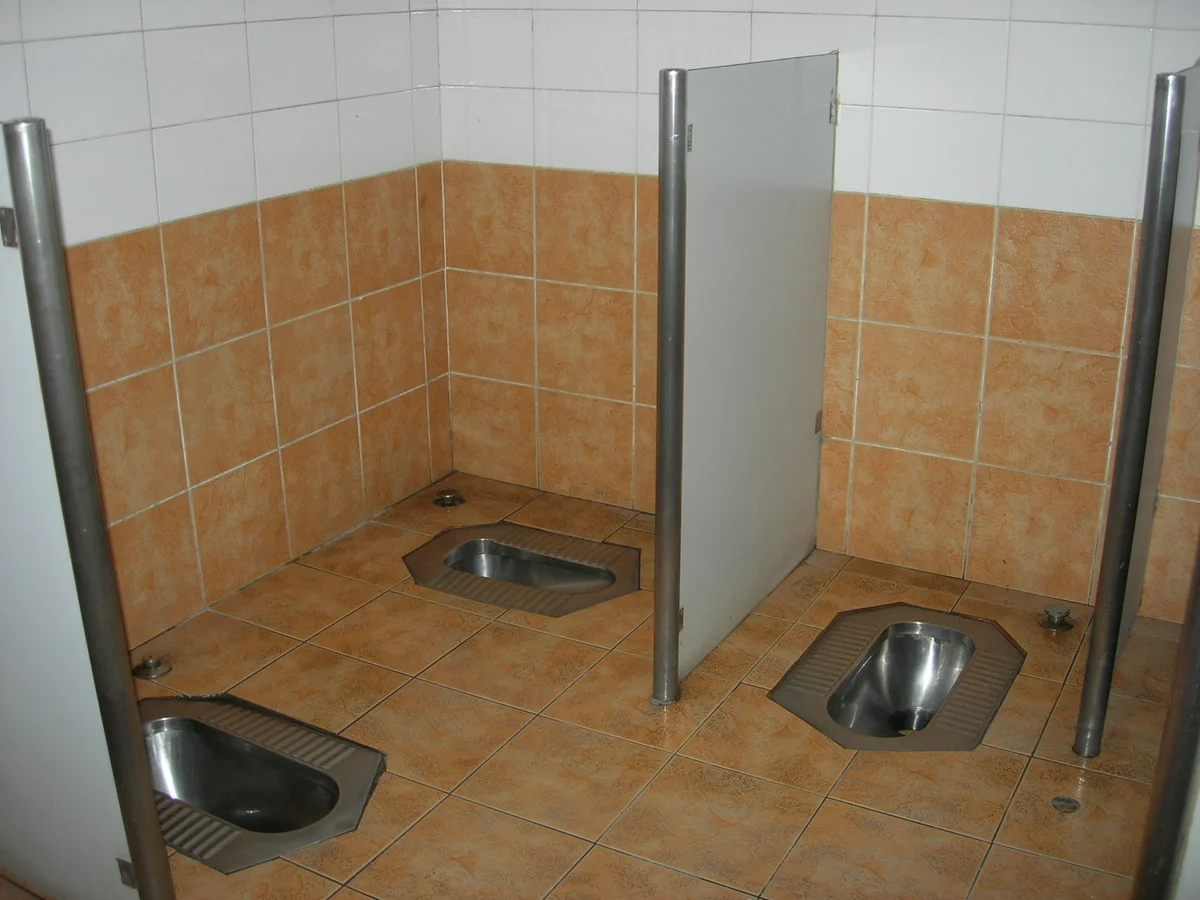
Squat toilets are still very common in China. In Chinese they're called 蹲便器 (dūn biàn qì).
How to find a sit-down toilet: check the sign outside
In many restrooms there's a pictogram on the stall door or wall showing whether it's a squat or a sit-down toilet.
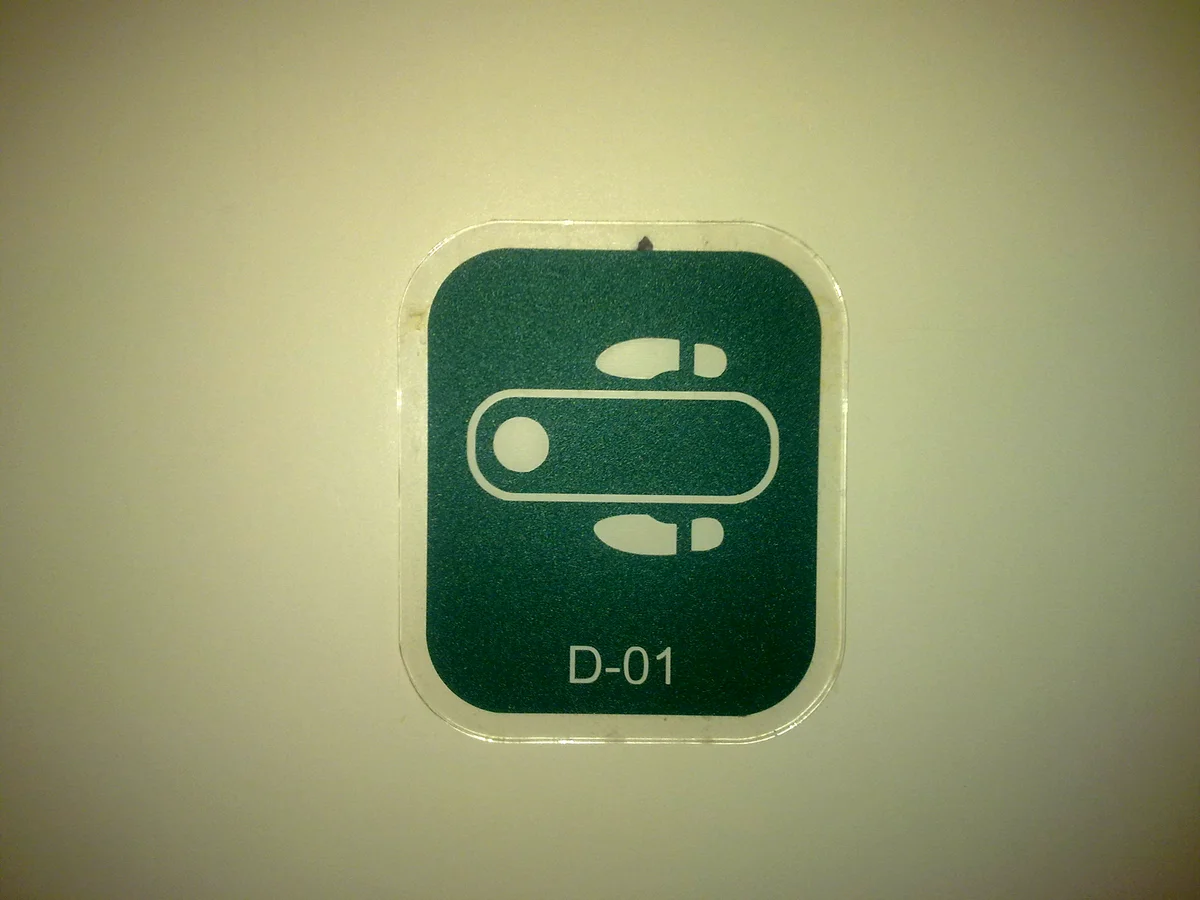
Two footprints means a squat toilet. A sit-down toilet is shown with a toilet seat. Check the sign before you open the door and you won't end up in the wrong one.
A sit-down (Western-style) toilet is 坐便器 (zuò biàn qì). To ask "Is there a sit-down toilet?", say "有坐便器吗?" (yǒu zuò biàn qì ma?).
Which way to face
Most Chinese squat toilets are flat, with no raised hood at one end, so it's not obvious which way to face.
The rule is simple: face away from the drain hole — your back should be toward the end with the hole where the water flows away. Remember that and you won't go wrong.
Some have the drain hole on the door side, so don't assume the direction from where you came in. Always check where the hole is first.
Many Chinese people think squat toilets are more hygienic
This is a big difference in thinking that I only learned after moving here.
Many visitors see squat toilets as old-fashioned and sit-down toilets as the clean, modern option. But in China, plenty of people consider squat toilets more hygienic.
The reason: with a sit-down toilet, your skin touches the seat. With a squat toilet, nothing touches you. So the idea of sitting where a stranger just sat is what puts people off.
My wife is Chinese, and she picks the squat toilet even when a sit-down one is free. And if all the squat toilets are taken and only a sit-down one is left, she lays tissue over the seat so her skin doesn't touch it. She says lots of people do this.
"Ugh, only squat toilets left" is a visitor's way of seeing it — locals may actually be queuing for the squat ones. Knowing that changes how Chinese toilets look a little.
🚬 A big difference — people smoking inside restrooms
This one always gets a "wait, what?" reaction, so I'll mention it up front.
In China, quite a few people smoke inside restrooms.
Shopping malls, office buildings, stations — it's the same everywhere. You walk in and the air is full of cigarette smoke. There's a "禁止吸烟" (No Smoking) sign on the wall. People smoke anyway.
Honestly, I don't fully understand why. In a mall you could just step outside. But the reality is that many people treat the restroom as a smoking room.
A few small ways to avoid it if the smell bothers you:
- 🏢 In malls, use restrooms on the upper floors — floors that are quieter than the restaurant or cinema levels have fewer people and less smoke
- ☕ Use restrooms in cafés or hotel lobbies — a small restroom with only one or two stalls rarely gets smokers
- 🚇 Prefer malls and airports over metro stations — the busier and more transit-like the place, the more smoke tends to linger
Lower your expectations about the smell a little — that's the best defense.
🏢 5 places where you'll reliably find a clean toilet
Now the practical part. If you choose where you go, you avoid almost every problem above.
When I show visitors around China, this is the order I aim for.
#1: Shopping malls 🥇
Hands down the best option. Malls in Chinese cities are big and new, and their restrooms are clean. They often have paper, and there's always a sit-down toilet.
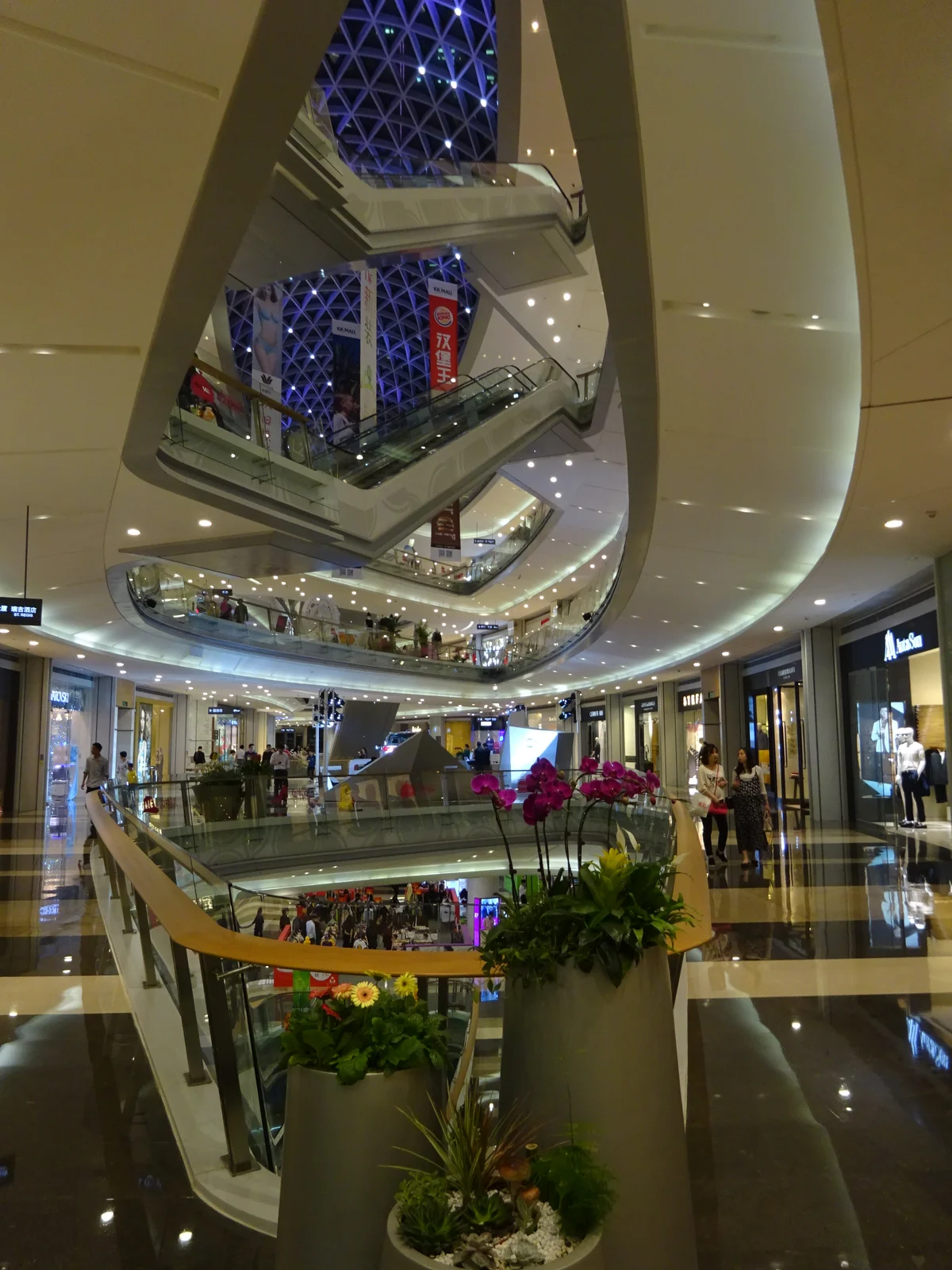
Chinese cities are full of malls. When you need a toilet, look for a mall first — that's the basic strategy.
#2: Metro stations 🚇
Metro stations in China have toilets, often inside the fare gates, so it's efficient to go before or after your ride. The newer the line, the cleaner the station.
#3: Starbucks and McDonald's ☕
You can pop in, just like at home. Chinese cities have countless Starbucks, Luckin Coffee and McDonald's branches, so they're easy to find.
If a toilet is what you're after, a standalone street-front Starbucks or a large McDonald's with lots of seating is the safer bet.
#4: Hotel lobbies 🏨
Even if you're not staying there, you can usually use the lobby restroom of a large hotel. Cleanliness guaranteed.
#5: Public toilets (公厕) 🚻
Chinese cities have lots of free public toilets. Look for green or blue signs saying "公厕" or "公共厕所".
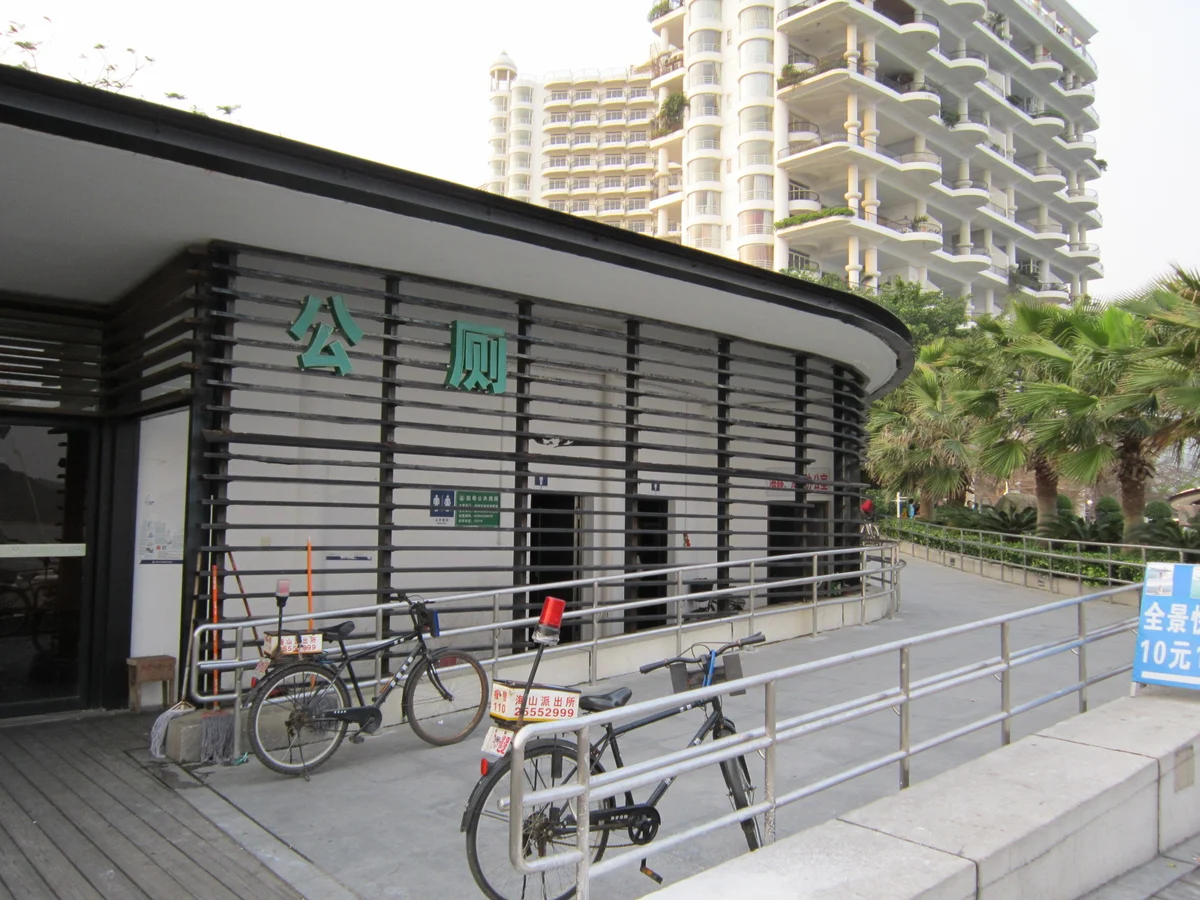
Just learning to recognize these two characters (公厕) makes walking around the city much less stressful. They're generally free, and many are open 24 hours. Quality varies, though, so if there's a mall nearby, go there first.
🗺️ Finding a toilet with Amap
When you need the nearest toilet right now, Amap (Gaode Maps) is the fastest way. Google Maps doesn't work well in China, but Amap has public toilets mapped everywhere.
If you can't type Chinese, just copy and paste "厕所" from this article. That's the quickest way.
⭐ Tourist-site toilets come with star ratings
One fun part of China's toilet story is that the government has made a serious effort to improve them.
In 2015, China launched the "Toilet Revolution" (厕所革命). Seeing dirty toilets as a major obstacle to tourism, it built and renovated public toilets on a national scale.
As a result, you'll now see signs like this at tourist sites:
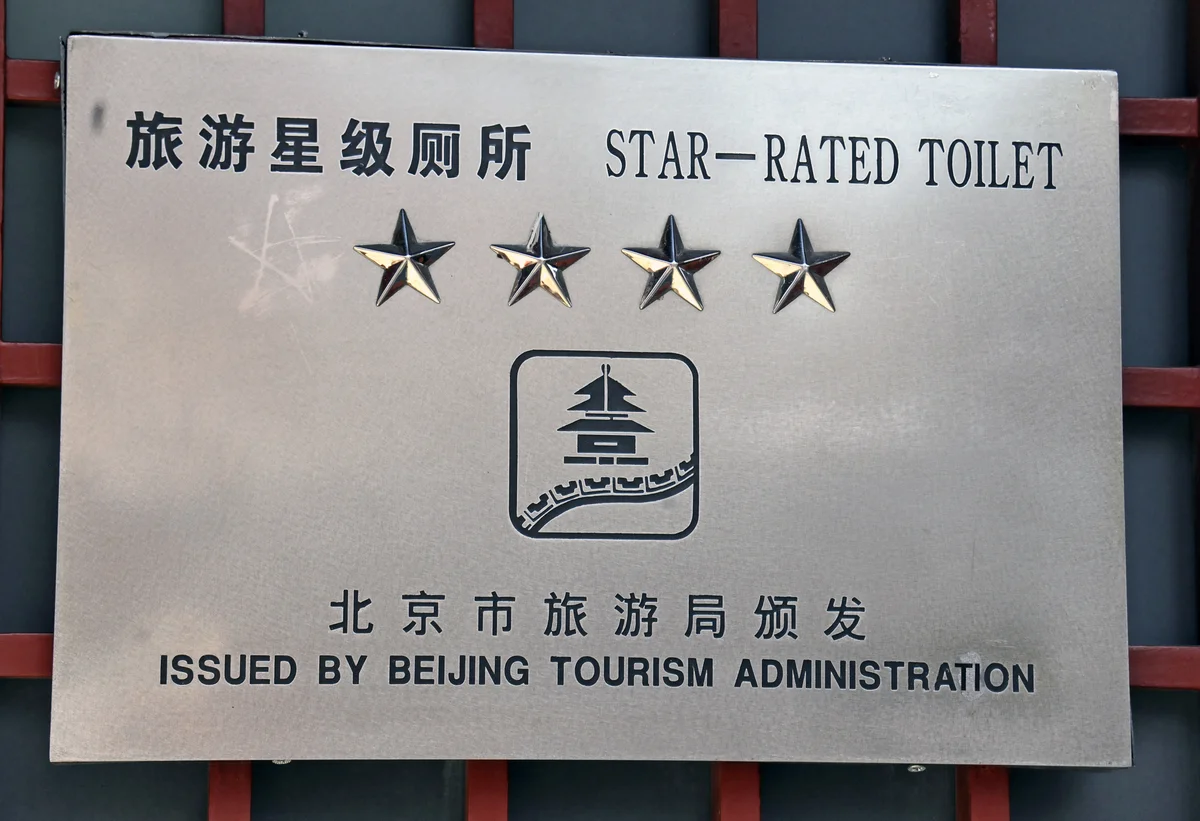
"旅游星级厕所 (STAR-RATED TOILET)" — a star rating for tourist toilets. This one has four stars, issued by the Beijing tourism authorities.
The image of "dirty Chinese toilets" largely dates from before the mid-2010s. Some places are still rough, of course, but toilets in cities and at tourist sites are a different world from ten years ago.
🗣️ Useful Chinese words
These are all the toilet-related words you'll need:
| English | Chinese | Pinyin |
|---|---|---|
| Restroom (polite) | 洗手间 | xǐshǒujiān |
| Restroom (common) | 卫生间 | wèishēngjiān |
| Toilet (public) | 厕所 | cèsuǒ |
| Public toilet | 公厕 | gōngcè |
| Excuse me, where's the restroom? | 请问,洗手间在哪里? | qǐngwèn, xǐshǒujiān zài nǎlǐ? |
| Men | 男 | nán |
| Women | 女 | nǚ |
| Occupied | 有人 | yǒu rén |
| Tissues | 纸巾 | zhǐjīn |
| Is there a sit-down toilet? | 有坐便器吗? | yǒu zuò biàn qì ma? |
If you'd like to prepare a little more Chinese, see 30 Chinese phrases that actually work in China.
🎒 What to bring from home
Here's what I always recommend packing for toilet emergencies:
- 🧻 Pocket tissues (plenty) — the one must-have. Around ten packs
- 🧼 Wet wipes — for your hands; Chinese restrooms sometimes have no soap
- 🧴 Hand sanitizer — backup for when the tap doesn't work
- 🪑 Toilet seat sanitizing wipes — if that matters to you; they're hard to find in China
- 🛍️ Small plastic bags — handy for carrying used tissue, or so you don't have to put your things on the floor
❓ FAQ
Q. Do you have to pay to use toilets in China? A. Generally no. Public toilets, malls and metro stations are free. A very small number of tourist sites still charge 1–2 yuan, but you're unlikely to come across one.
Q. What about toilets on high-speed trains? A. Each carriage has both sit-down and squat toilets. They're kept clean, but paper sometimes runs out, so bring your own. I explain how to take the high-speed train in this guide to booking train tickets.
Q. Is it true there are toilets with no doors? A. You'll hardly ever see one in a city. The partition-free "ni hao toilets" of the past survive only in some rural areas and old facilities. If you're visiting Beijing, Shanghai, Shenzhen or Guangzhou, there's no need to worry.
Q. Are there bidet toilets? A. Almost never. Some upscale hotel rooms have them, but don't expect them in public restrooms.
Q. Anything women should know? A. Many stalls have no hook for your bag, so a crossbody bag is the easiest option. Also, bring the period products you're used to — you can buy them in China, but the brands may be different from what you know.
Q. Is it OK with kids? A. Malls have parent-and-baby rooms (母婴室) and accessible restrooms with changing tables. Learning the three characters 母婴室 makes them easy to find.
✅ Summary
Toilets in China, in a nutshell 🚻
- 🧻 Some places have no paper. Always carry pocket tissues — that solves 90% of problems
- 🗑️ Some places say don't flush paper. A bin in the stall is the signal to use it
- 🚾 Lots of squat toilets. Check the sign outside the stall to find a sit-down one. Many Chinese people think squat toilets are more hygienic
- 🚬 People smoke in restrooms. Probably the biggest surprise. Lower your expectations about the smell
- 🏢 Head for malls and metro stations. Choose where you go and you'll rarely have problems — but some Starbucks and McDonald's branches have no toilet
- ⭐ "Chinese toilets are dirty" is old news. Since the Toilet Revolution, cities have completely changed
What I tell every friend who visits is: "Don't let toilet worries make your trip smaller." Put a pack of tissues in your pocket, and you can walk around Chinese cities just fine.
The preparation takes five minutes before you leave. Add one line to your packing list 😊
📚 Read next
- 🎒 6 Things You Must Know Before Traveling to China — the big picture of pre-trip preparation, including other culture gaps besides toilets
- 🗺️ How to Use Amap (Gaode Maps) in China — essential for searching "厕所" to find a toilet, since Google Maps doesn't work well
- 🗣️ 30 Chinese Phrases That Actually Work in China — including "洗手间在哪里?" and other phrases you'll really use
- 🚇 How to Ride the Metro in China — metro stations are a great source of clean toilets
- 🛡️ Is China Safe for Tourists? — how to look after your belongings in China, restrooms included
Information current as of October 2026.
Image credits: Wikimedia Commons — public toilet at Liwan Lake Park, Guangzhou: MeiOLA 2290 WMENSZ (CC0) / smart toilet board at Chengdu Tianfu International Airport: Nord794ub (CC BY-SA 4.0) / metro station toilet in Pingshan, Shenzhen: GepeKuenz Yueam (CC0) / squat toilets in a Chinese public restroom: Oskarp (CC BY-SA 3.0) / squat toilet sign: Donald Trung (CC BY-SA 4.0) / KK Mall, Shenzhen: Deuallangpoa (CC BY-SA 4.0) / "公厕" public toilet: Wrightbus (CC BY-SA 3.0) / star-rated toilet sign in Beijing: Daniel Case (CC BY-SA 3.0)